MoreExam
1. Question Content...
EXPLANATION
Answer: X - EXPLANATION Content.
Question1: What is true about automating interactions with Anypoint Platform using tools such as Anypoint Platform REST API's, Anypoint CLI or the Mule Maven plugin?
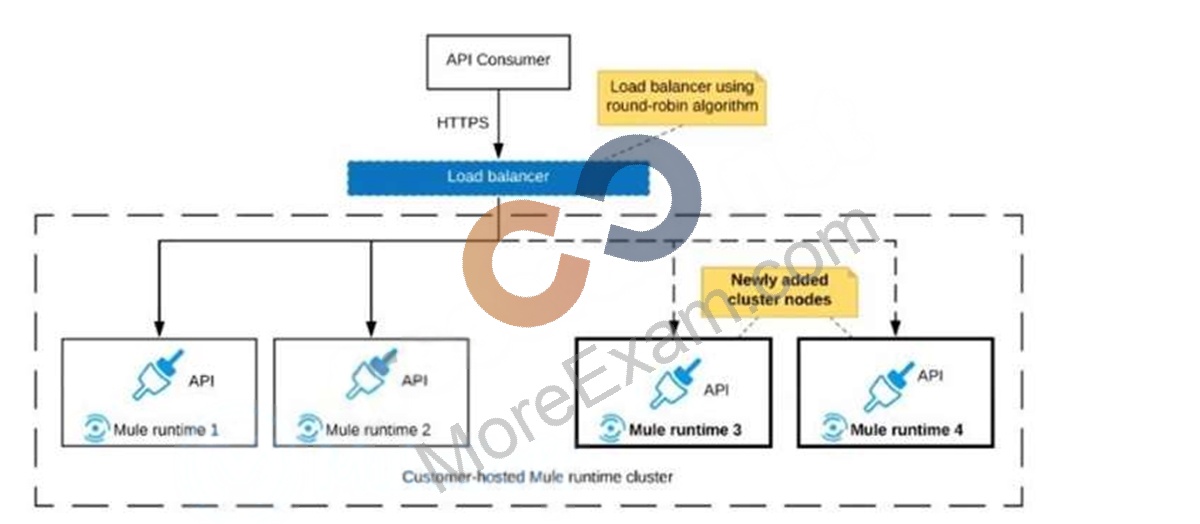
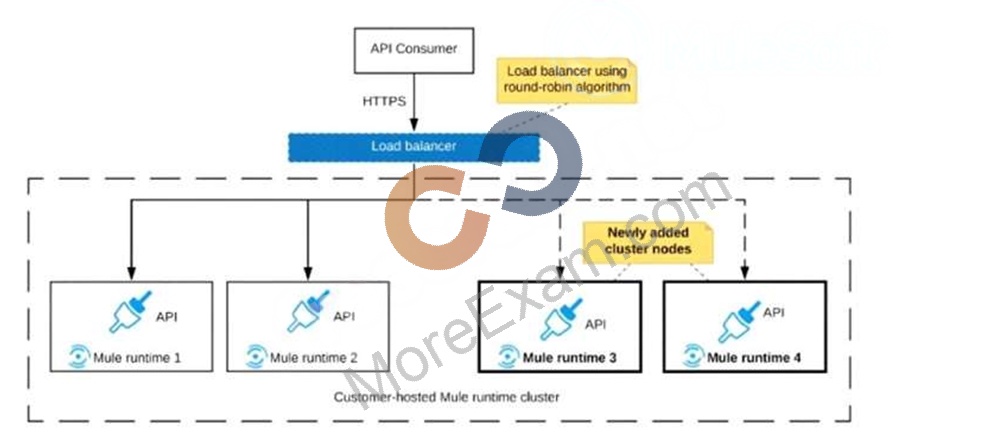
Question2: Refer to the exhibit.An organization uses a 2-node Mute runtime cluster to host one stateless API implementation. The API is accessed over HTTPS through a load balancer that uses round-robin for load distribution.Two additional nodes have been added to the cluster and the load balancer has been configured to recognize the new nodes with no other change to the load balancer.What average performance change is guaranteed to happen, assuming all cluster nodes are fully operational?
Question3: A company is building an application network and has deployed four Mule APIs: one experience API, one process API, and two system APIs. The logs from all the APIs are aggregated in an external log aggregation tool. The company wants to trace messages that are exchanged between multiple API implementations. What is the most idiomatic (based on its intended use) identifier that should be used to implement Mule event tracing across the multiple API implementations?
Question4: An integration Mule application is deployed to a customer-hosted multi-node Mule 4 runtime duster. The Mule application uses a Listener operation of a JMS connector to receive incoming messages from a JMS queue.How are the messages consumed by the Mule application?
Question5: An organization has implemented a continuous integration (CI) lifecycle that promotes Mule applications through code, build, and test stages. To standardize the organization's CI journey, a new dependency control approach is being designed to store artifacts that include information such as dependencies, versioning, and build promotions.To implement these process improvements, the organization will now require developers to maintain all dependencies related to Mule application code in a shared location.What is the most idiomatic (used for its intended purpose) type of system the organization should use in a shared location to standardize all dependencies related to Mule application code?
Question6: An external REST client periodically sends an array of records in a single POST request to a Mule application API endpoint.The Mule application must validate each record of the request against a JSON schema before sending it to a downstream system in the same order that it was received in the array Record processing will take place inside a router or scope that calls a child flow. The child flow has its own error handling defined. Any validation or communication failures should not prevent further processing of the remaining records.To best address these requirements what is the most idiomatic(used for it intended purpose) router or scope to used in the parent flow, and what type of error handler should be used in the child flow?
Question7: An organization has decided on a cloudhub migration strategy that aims to minimize the organizations own IT resources. Currently, the organizational has all of its Mule applications running on its own premises and uses an premises load balancer that exposes all APIs under the base URL https://api.acme.com As part of the migration strategy, the organization plans to migrate all of its Mule applications and load balancer to cloudhub What is the most straight-forward and cost effective approach to the Mule applications deployment and load balancing that preserves the public URLs?
Question8: An integration Mule application is deployed to a customer-hosted multi-node Mule 4 runtime duster. The Mule application uses a Listener operation of a JMS connector to receive incoming messages from a JMS queue.How are the messages consumed by the Mule application?
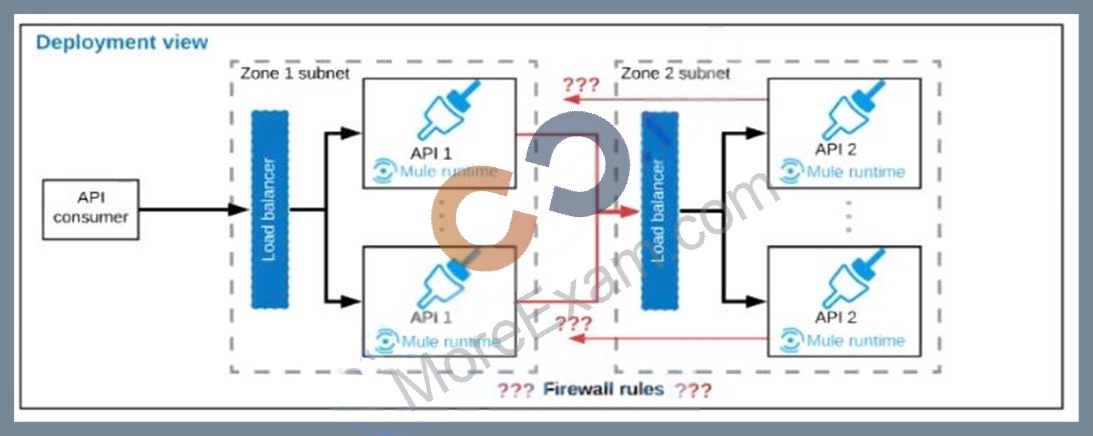
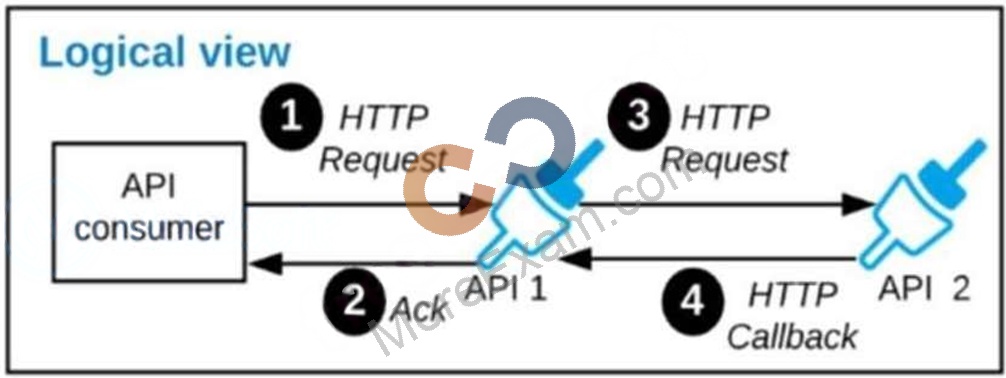
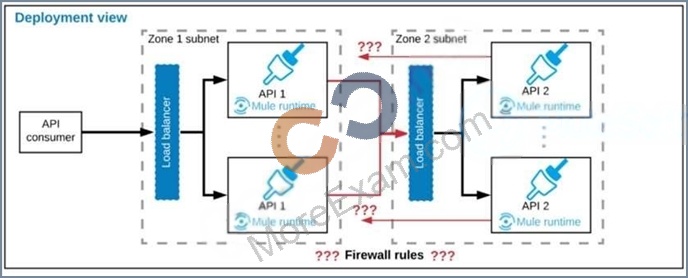
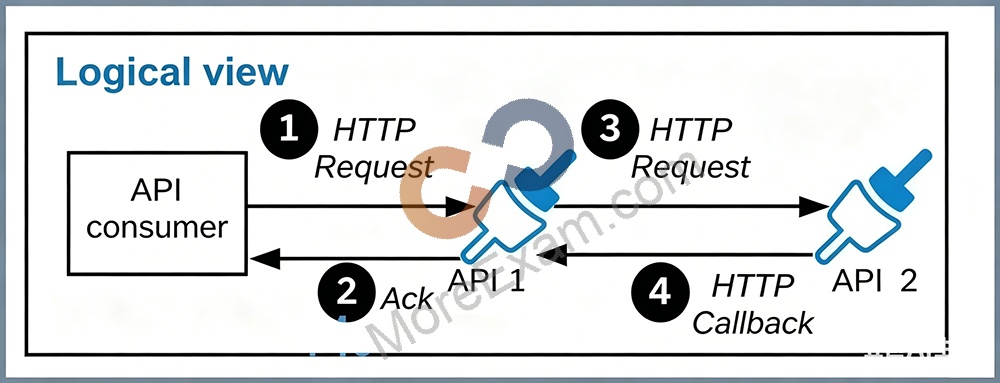
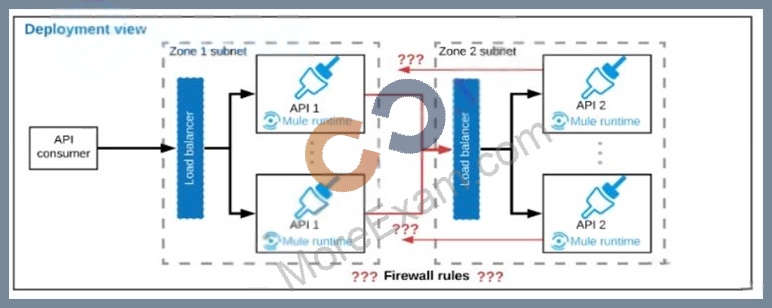
Question9: Refer to the exhibit.A business process involves two APIs that interact with each other asynchronously over HTTP. Each API is implemented as a Mule application. API 1 receives the initial HTTP request and invokes API 2 (in a fire and forget fashion) while API 2, upon completion of the processing, calls back into API l to notify about completion of the asynchronous process.Each API Is deployed to multiple redundant Mule runtimes and a separate load balancer, and is deployed to a separate network zone.In the network architecture, how must the firewall rules be configured to enable the above Interaction between API 1 and API 2?
Question10: What comparison is true about a CloudHub Dedicated Load Balancer (DLB) vs. the CloudHub Shared Load Balancer (SLB)?
Question11: Refer to the exhibit. A business process involves two APIs that interact with each other asynchronously over HTTP. Each API is implemented as a Mule application. API 1 receives the initial HTTP request and invokes API 2 (in a fire and forget fashion) while API 2, upon completion of the processing, calls back into API 1 to notify about completion of the asynchronous process.Each API is deployed to multiple redundant Mule runtimes and a separate load balancer, and is deployed to a separate network zone.In the network architecture, how must the firewall rules be configured to enable the above interaction between API 1 and API 2?
Question12: When using Anypoint Platform across various lines of business with their own Anypoint Platform business groups, what configuration of Anypoint Platform is always performed at the organization level as opposed to at the business group level?
Question13: An organization is designing a Mule application to periodically poll an SFTP location for new files containing sales order records and then process those sales orders. Each sales order must be processed exactly once.To support this requirement, the Mule application must identify and filter duplicate sales orders on the basis of a unique ID contained in each sales order record and then only send the new sales orders to the downstream system.What is the most idiomatic (used for its intended purpose) Anypoint connector, validator, or scope that can be configured in the Mule application to filter duplicate sales orders on the basis of the unique ID field contained in each sales order record?
Question14: Refer to the exhibit.An organization uses a 2-node Mute runtime cluster to host one stateless API implementation. The API is accessed over HTTPS through a load balancer that uses round-robin for load distribution.Two additional nodes have been added to the cluster and the load balancer has been configured to recognize the new nodes with no other change to the load balancer.What average performance change is guaranteed to happen, assuming all cluster nodes are fully operational?
Question15: An organization is designing the following two Mule applications that must share data via a common persistent object store instance:- Mule application P will be deployed within their on-premises datacenter.- Mule application C will run on CloudHub in an Anypoint VPC.The object store implementation used by CloudHub is the Anypoint Object Store v2 (OSv2).what type of object store(s) should be used, and what design gives both Mule applications access to the same object store instance?
Question16: An organization will deploy Mule applications to CloudHub. Business requirements mandate that all application logs be stored ONLY in an external Splunk consolidated logging service and NOT in CloudHub.In order to most easily store Mule application logs ONLY in Splunk, how must Mule application logging be configured in Runtime Manager, and where should the log4j2 Splunk appender be defined?
Question17: An organization is sizing an Anypoint VPC to extend their internal network to Cloudhub.For this sizing calculation, the organization assumes 150 Mule applications will be deployed among three(3) production environments and will use Cloudhub's default zero-downtime feature. Each Mule application is expected to be configured with two(2) Cloudhub workers.This is expected to result in several Mule application deployments per hour.
Question18: What comparison is true about a CloudHub Dedicated Load Balancer (DLB) vs. the CloudHub Shared Load Balancer (SLB)?
Question19: Refer to the exhibit.A business process involves two APIs that interact with each other asynchronously over HTTP. Each API is implemented as a Mule application. API 1 receives the initial HTTP request and invokes API 2 (in a fire and forget fashion) while API 2, upon completion of the processing, calls back into API l to notify about completion of the asynchronous process.Each API Is deployed to multiple redundant Mule runtimes and a separate load balancer, and is deployed to a separate network zone.In the network architecture, how must the firewall rules be configured to enable the above Interaction between API 1 and API 2?
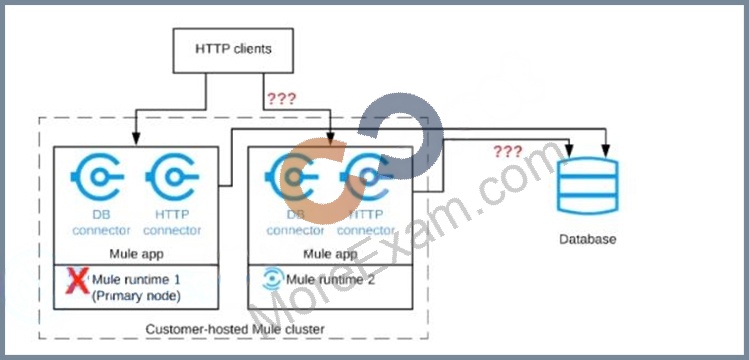
Question20: Refer to the exhibit.A Mule application is deployed to a cluster of two customer-hosted Mute runtimes. The Mute application has a flow that polls a database and another flow with an HTTP Listener.HTTP clients send HTTP requests directly to individual cluster nodes.What happens to database polling and HTTP request handling in the time after the primary (master) node of the cluster has railed, but before that node is restarted?
Question21: A Mule application is being designed To receive nightly a CSV file containing millions of records from an external vendor over SFTP, The records from the file need to be validated, transformed. And then written to a database. Records can be inserted into the database in any order.In this use case, what combination of Mule components provides the most effective and performant way to write these records to the database?
Question22: A Mule application is being designed to perform product orchestration. The Mule application needs to join together the responses from an Inventory API and a Product Sales History API with the least latency.To minimize the overall latency, what is the most idiomatic (used for its intended purpose) design to call each API request in the Mule application?
Question23: An integration Mute application is being designed to process orders by submitting them to a backend system for offline processing. Each order will be received by the Mute application through an HTTPS POST and must be acknowledged immediately. Once acknowledged, the order will be submitted to a backend system. Orders that cannot be successfully submitted due to rejections from the backend system will need to be processed manually (outside the backend system).The Mule application will be deployed to a customer-hosted runtime and is able to use an existing ActiveMQ broker if needed.The backend system has a track record of unreliability both due to minor network connectivity issues and longer outages.What idiomatic (used for their intended purposes) combination of Mule application components and ActiveMQ queues are required to ensure automatic submission of orders to the backend system, while minimizing manual order processing?
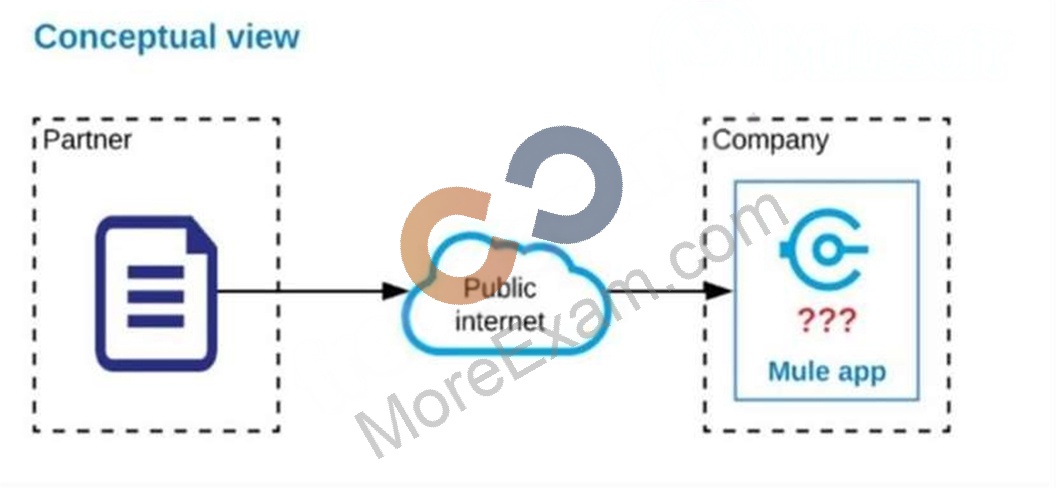
Question24: Refer to the exhibit. An organization is designing a Mule application to receive data from one external business partner. The two companies currently have no shared IT infrastructure and do not want to establish one.Instead, all communication should be over the public internet (with no VPN).What Anypoint Connector can be used in the organization's Mule application to securely receive data from this external business partner?
Question25: In Anypoint Platform, a company wants to configure multiple identity providers(Idps) for various lines of business (LOBs) Multiple business groups and environments have been defined for the these LOBs. What Anypoint Platform feature can use multiple Idps access the company's business groups and environment?
Question26: Refer to the exhibit.A Mule application is deployed to a cluster of two customer-hosted Mute runtimes. The Mute application has a flow that polls a database and another flow with an HTTP Listener.HTTP clients send HTTP requests directly to individual cluster nodes.What happens to database polling and HTTP request handling in the time after the primary (master) node of the cluster has railed, but before that node is restarted?
Question27: An organization currently uses a multi-node Mule runtime deployment model within their datacenter, so each Mule runtime hosts several Mule applications. The organization is planning to transition to a deployment model based on Docker containers in a Kubernetes cluster. The organization has already created a standard Docker image containing a Mule runtime and all required dependencies (including a JVM), but excluding the Mule application itself.What is an expected outcome of this transition to container-based Mule application deployments?
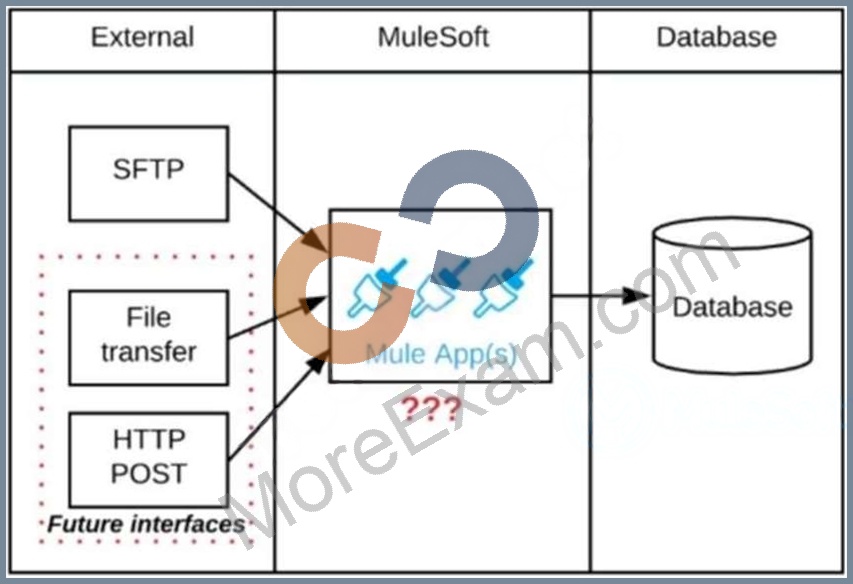
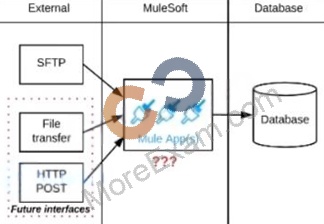
Question28: Refer to the exhibit. A business process involves the receipt of a file from an external vendor over SFTP. The file needs to be parsed and its content processed, validated, and ultimately persisted to a database. The delivery mechanism is expected to change in the future as more vendors send similar files using other mechanisms such as file transfer or HTTP POST.What is the most effective way to design for these requirements in order to minimize the impact of future change?
Question29: An Integration Mule application is being designed to synchronize customer data between two systems. One system is an IBM Mainframe and the other system is a Salesforce Marketing Cloud (CRM) instance. Both systems have been deployed in their typical configurations, and are to be invoked using the native protocols provided by Salesforce and IBM.What interface technologies are the most straightforward and appropriate to use in this Mute application to interact with these systems, assuming that Anypoint Connectors exist that implement these interface technologies?
Question30: 49 of A popular retailer is designing a public API for its numerous business partners. Each business partner will invoke the API at the URL 58. https://api.acme.com/partnefs/vl. The API implementation is estimated to require deployment to 5 CloudHub workers.The retailer has obtained a public X.509 certificate for the name apl.acme.com, signed by a reputable CA, to be used as the server certificate.Where and how should the X.509 certificate and Mule applications be used to configure load balancing among the 5 CloudHub workers, and what DNS entries should be configured in order for the retailer to support its numerous business partners?
Question31: The AnyAirline organization's passenger reservations center is designing an integration solution that combines invocations of three different System APIs (bookFlight, bookHotel, and bookCar) in a business transaction. Each System API makes calls to a single database.The entire business transaction must be rolled back when at least one of the APIs fails.What is the most idiomatic (used for its intended purpose) way to integrate these APIs in near real-time that provides the best balance of consistency, performance, and reliability?
Question32: How are the API implementation , API client, and API consumer combined to invoke and process an API ?
Question33: What Is a recommended practice when designing an integration Mule 4 application that reads a large XML payload as a stream?
Question34: An organization has several APIs that accept JSON data over HTTP POST. The APIs are all publicly available and are associated with several mobile applications and web applications. The organization does NOT want to use any authentication or compliance policies for these APIs, but at the same time, is worried that some bad actor could send payloads that could somehow compromise the applications or servers running the API implementations. What out-of-the-box Anypoint Platform policy can address exposure to this threat?
Question35: When designing an upstream API and its implementation, the development team has been advised to not set timeouts when invoking downstream API. Because the downstream API has no SLA that can be relied upon. This is the only donwstream API dependency of that upstream API. Assume the downstream API runs uninterrupted without crashing. What is the impact of this advice?
Question36: An organization is migrating all its Mule applications to Runtime Fabric (RTF). None of the Mule applications use Mule domain projects.Currently, all the Mule applications have been manually deployed to a server group among several customer- hosted Mule runtimes. Port conflicts between these Mule application deployments are currently managed by the DevOps team who carefully manage Mule application properties files.When the Mule applications are migrated from the current customer-hosted server group to Runtime Fabric (RTF), do the Mule applications need to be rewritten, and what DevOps port configuration responsibilities change or stay the same?
Question37: What aspects of a CI/CD pipeline for Mute applications can be automated using MuleSoft-provided Maven plugins?
Question38: An integration Mule application is being designed to synchronize customer data between two systems. One system is an IBM Mainframe and the other system is a Salesforce Marketing Cloud (CRM) instance. Both systems have been deployed in their typical configurations, and are to be invoked using the native protocols provided by Salesforce and IBM.What interface technologies are the most straightforward and appropriate to use in this Mule application to interact with these systems, assuming that Anypoint Connectors exist that implement these interface technologies?
Question39: An organizationis designing a mule application to support an all or nothing transaction between serval database operations and some other connectors so that they all roll back if there is a problem with any of the connectors Besides the database connector , whatother connector can be used in the transaction.
Question40: What best describes the Fully Qualified Domain Names (FQDNs), also known as DNS entries, created when a Mule application is deployed to the CloudHub Shared Worker Cloud?
Question41: Refer to the exhibit.A Mule application is deployed to a cluster of two customer-hosted Mute runtimes. The Mute application has a flow that polls a database and another flow with an HTTP Listener.HTTP clients send HTTP requests directly to individual cluster nodes.What happens to database polling and HTTP request handling in the time after the primary (master) node of the cluster has railed, but before that node is restarted?
Question42: An organization is sizing an Anypoint VPC to extend their internal network to Cloudhub.For this sizing calculation, the organization assumes 150 Mule applications will be deployed among three(3) production environments and will use Cloudhub's default zero-downtime feature. Each Mule application is expected to be configured with two(2) Cloudhub workers.This is expected to result in several Mule application deployments per hour.
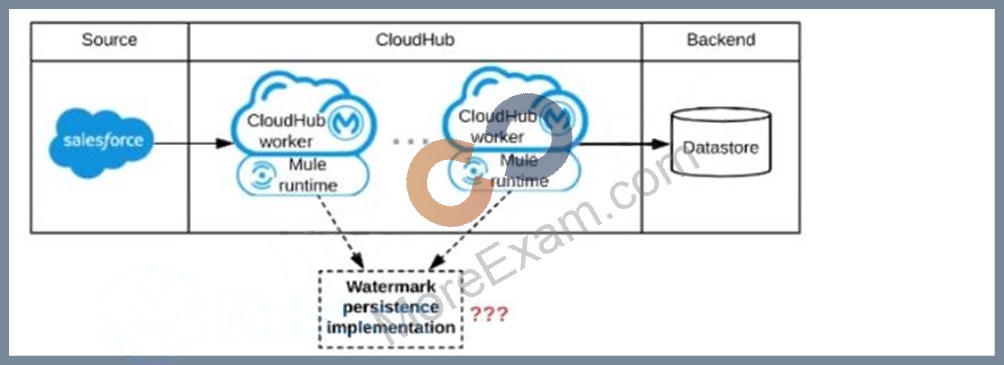
Question43: Refer to the exhibit.A Mule application is being designed to be deployed to several CIoudHub workers. The Mule application's integration logic is to replicate changed Accounts from Satesforce to a backend system every 5 minutes.A watermark will be used to only retrieve those Satesforce Accounts that have been modified since the last time the integration logic ran.What is the most appropriate way to implement persistence for the watermark in order to support the required data replication integration logic?
Question44: What is true about the network connections when a Mule application uses a JMS connector to interact with a JMS provider (message broker)?
Question45: A Mule application uses an HTTP Request operation to invoke an external API.The external API follows the HTTP specification for proper status code usage.What is a possible cause when a 3xx status code is returned to the HTTP Request operation from the external API?
Question46: An organization uses a set of customer-hosted Mule runtimes that are managed using the Mulesoft-hosted control plane. What is a condition that can be alerted on from Anypoint Runtime Manager without any custom components or custom coding?
Question47: A Mule application uses the Database connector.What condition can the Mule application automatically adjust to or recover from without needing to restart or redeploy the Mule application?
Question48: A travel company wants to publish a well-defined booking service API to be shared with its business partners. These business partners have agreed to ONLY consume SOAP services and they want to get the service contracts in an easily consumable way before they start any development. The travel company will publish the initial design documents to Anypoint Exchange, then share those documents with the business partners. When using an API-led approach, what is the first design document the travel company should deliver to its business partners?
Question49: A mule application uses an HTTP request operation to involve an external API.The external API follows the HTTP specification for proper status code usage.What is possible cause when a 3xx status code is returned to the HTTP Request operation from the external API?
Question50: A new Mule application under development must implement extensive data transformation logic. Some of the data transformation functionality is already available as external transformation services that are mature and widely used across the organization; the rest is highly specific to the new Mule application.The organization follows a rigorous testing approach, where every service and application must be extensively acceptance tested before it is allowed to go into production.What is the best way to implement the data transformation logic for this new Mule application while minimizing the overall testing effort?
Question51: An organization's security policies mandate complete control of the login credentials used to log in to Anypoint Platform.What feature of Anypoint Platform should be used to meet this requirement?
Question52: An organization is sizing an Anypoint VPC to extend their internal network to Cloudhub.For this sizing calculation, the organization assumes 150 Mule applications will be deployed among three(3) productionenvironments and will use Cloudhub's default zero-downtime feature. Each Mule application is expected to be configured with two(2) Cloudhub workers.This is expected to result in several Mule application deployments per hour.
Question53: What condition requires using a CloudHub Dedicated Load Balancer?
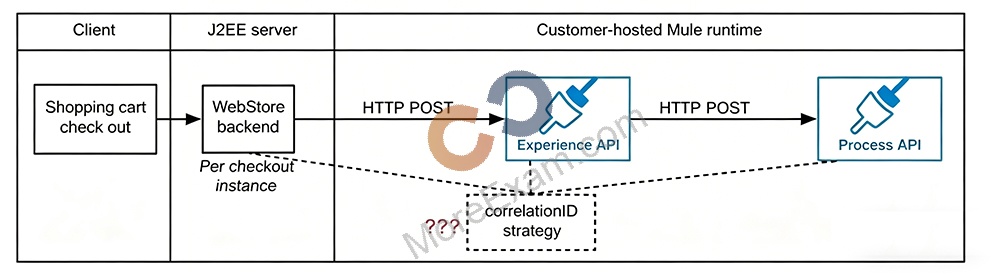
Question54: Refer to the exhibit.A shopping cart checkout process consists of a web store backend sending a sequence of API invocations to an Experience API, which in turn invokes a Process API. All API invocations are over HTTPS POST. The Java web store backend executes in a Java EE application server, while all API implementations are Mule applications executing in a customer -hosted Mule runtime.End-to-end correlation of all HTTP requests and responses belonging to each individual checkout Instance is required. This is to be done through a common correlation ID, so that all log entries written by the web store backend, Experience API implementation, and Process API implementation include the same correlation ID for all requests and responses belonging to the same checkout instance.What is the most efficient way (using the least amount of custom coding or configuration) for the web store backend and the implementations of the Experience API and Process API to participate in end-to-end correlation of the API invocations for each checkout instance?
Question55: A new Mule application under development must implement extensive data transformation logic. Some of the data transformation functionality is already available as external transformation services that are mature and widely used across the organization; the rest is highly specific to the new Mule application.The organization follows a rigorous testing approach, where every service and application must be extensively acceptance tested before it is allowed to go into production.What is the best way to implement the data transformation logic for this new Mule application while minimizing the overall testing effort?
Question56: An organization is implementing a Quote of the Day API that caches today's quote. What scenario can use the CloudHub Object Store connector to persist the cache's state?
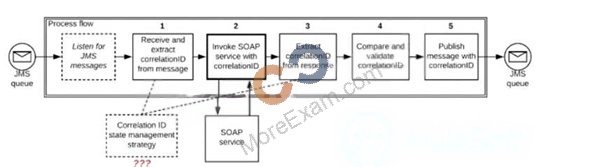
Question57: Refer to the exhibit.A Mule application is deployed to a multi-node Mule runtime cluster. The Mule application uses the competing consumer pattern among its cluster replicas to receive JMS messages from a JMS queue. To process each received JMS message, the following steps are performed in a flow:Step l: The JMS Correlation ID header is read from the received JMS message.Step 2: The Mule application invokes an idempotent SOAP webservice over HTTPS, passing the JMS Correlation ID as one parameter in the SOAP request.Step 3: The response from the SOAP webservice also returns the same JMS Correlation ID.Step 4: The JMS Correlation ID received from the SOAP webservice is validated to be identical to the JMS Correlation ID received in Step 1.Step 5: The Mule application creates a response JMS message, setting the JMS Correlation ID message header to the validated JMS Correlation ID and publishes that message to a response JMS queue.Where should the Mule application store the JMS Correlation ID values received in Step 1 and Step 3 so that the validation in Step 4 can be performed, while also making the overall Mule application highly available, fault-tolerant, performant, and maintainable?
Question58: An organization uses Mule runtimes which are managed by Anypoint Platform - Private Cloud Edition. What MuleSoft component is responsible for feeding analytics data to non-MuleSoft analytics platforms?
Question59: An organization has decided on a cloudhub migration strategy that aims to minimize the organizations own IT resources. Currently, the organizational has all of its Mule applications running on its own premises and uses an premises load balancer that exposes all APIs under the base URL https://api.acme.com As part of the migration strategy, the organization plans to migrate all of its Mule applications and load balancer to cloudhub What is the most straight-forward and cost effective approach to the Mule applications deployment and load balancing that preserves the public URLs?
Question60: What limits if a particular Anypoint Platform user can discover an asset in Anypoint Exchange?
Question61: Mule application is deployed to Customer Hosted Runtime. Asynchronous logging was implemented to improved throughput of the system. But it was observed over the period of time that few of the important exception log messages which were used to rollback transactions are not working as expected causing huge loss to the Organization. Organization wants to avoid these losses. Application also has constraints due to which they cant compromise on throughput much. What is the possible option in this case?
Question62: What aspects of a CI/CD pipeline for Mute applications can be automated using MuleSoft-provided Maven plugins?
Question63: A Mule application currently writes to two separate SQL Server database instances across the internet using a single XA transaction. It is proposed to split this one transaction into two separate non-XA transactions with no other changes to the Mule application.What non-functional requirement can be expected to be negatively affected when implementing this change?
Question64: A mule application is deployed to a Single Cloudhub worker and the public URL appears in Runtime Manager as the APP URL.Requests are sent by external web clients over the public internet to the mule application App url. Each of these requests routed to the HTTPS Listener event source of the running Mule application.Later, the DevOps team edits some properties of this running Mule application in Runtime Manager.Immediately after the new property values are applied in runtime manager, how is the current Mule application deployment affected and how will future web client requests to the Mule application be handled?
Question65: Mule applications need to be deployed to CloudHub so they can access on-premises database systems. These systems store sensitive and hence tightly protected data, so are not accessible over the internet.What network architecture supports this requirement?
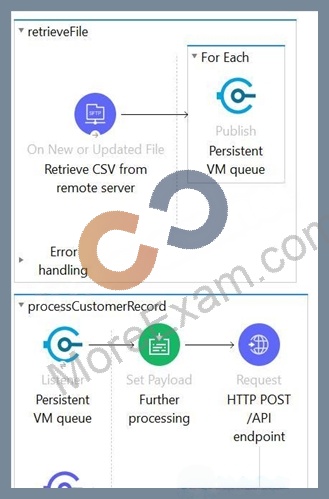
Question66: Refer to the exhibit.This Mule application is deployed to multiple Cloudhub workers with persistent queue enabled. The retrievefile flow event source reads a CSV file from a remote SFTP server and then publishes each record in the CSV file to a VM queue. The processCustomerRecords flow's VM Listner receives messages from the same VM queue and then processes each message separately.How are messages routed to the cloudhub workers as messages are received by the VM Listener?
Question67: An organization is creating a set of new services that are critical for their business. The project team prefers using REST for all services but is willing to use SOAP with common WS-" standards if a particular service requires it.What requirement would drive the team to use SOAP/WS-* for a particular service?
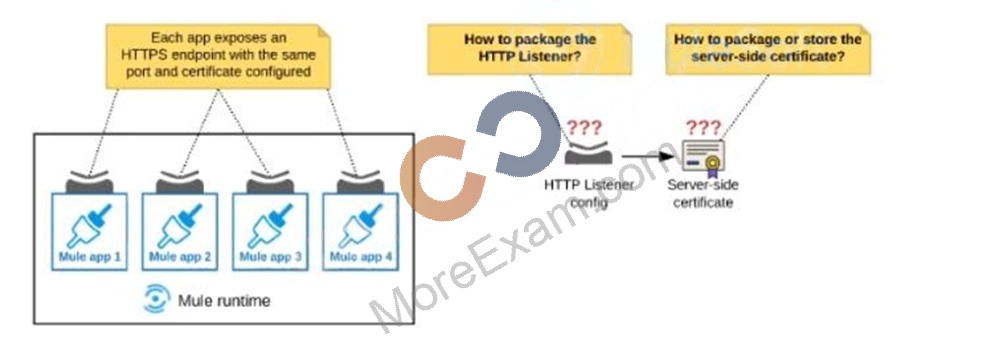
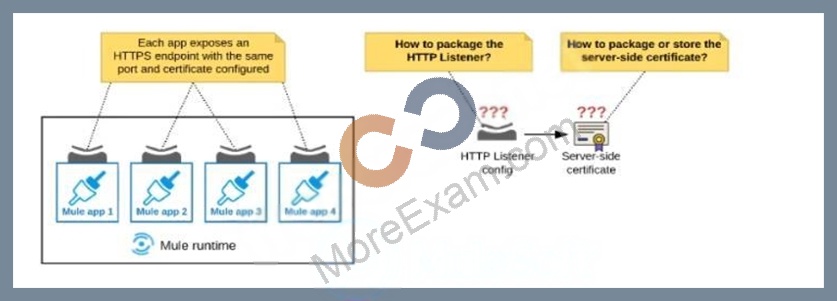
Question68: Refer to the exhibit.An organization deploys multiple Mule applications to the same customer -hosted Mule runtime. Many of these Mule applications must expose an HTTPS endpoint on the same port using a server-side certificate that rotates often.What is the most effective way to package the HTTP Listener and package or store the server-side certificate when deploying these Mule applications, so the disruption caused by certificate rotation is minimized?
Question69: A Mule application is being designed to do the following:Step 1: Read a SalesOrder message from a JMS queue, where each SalesOrder consists of a header and a list of SalesOrderLineltems.Step 2: Insert the SalesOrder header and each SalesOrderLineltem into different tables in an RDBMS.Step 3: Insert the SalesOrder header and the sum of the prices of all its SalesOrderLineltems into a table In a different RDBMS.No SalesOrder message can be lost and the consistency of all SalesOrder-related information in both RDBMSs must be ensured at all times.What design choice (including choice of transactions) and order of steps addresses these requirements?
Question70: What metrics about API invocations are available for visualization in custom charts using Anypoint Analytics?
Question71: Anypoint Exchange is required to maintain the source code of some of the assets committed to it, such as Connectors, Templates, and API specifications.What is the best way to use an organization's source-code management (SCM) system in this context?
Question72: A popular retailer is designing a public API for its numerous business partners. Each business partner will invoke the API at the URL https://api.acme.com/partners/v1. The API implementation is estimated to require deployment to 5 CloudHub workers.The retailer has obtained a public X.509 certificate for the name api.acme.com, signed by a reputable CA, to be used as the server certificate.Where and how should the X.509 certificate and Mule applications be used to configure load balancing among the 5 CloudHub workers, and what DNS entries should be configured in order for the retailer to support its numerous business partners?
Question73: An API has been unit tested and is ready for integration testing. The API is governed by a Client ID Enforcement policy in all environments.What must the testing team do before they can start integration testing the API in the Staging environment?
Question74: What limits if a particular Anypoint Platform user can discover an asset in Anypoint Exchange?
Question75: Mule applications need to be deployed to CloudHub so they can access on-premises database systems. These systems store sensitive and hence tightly protected data, so are not accessible over the internet.What network architecture supports this requirement?
Question76: A retailer is designing a data exchange interface to be used by its suppliers. The interface must support secure communication over the public internet. The interface must also work with a wide variety of programming languages and IT systems used by suppliers.What are suitable interface technologies for this data exchange that are secure, cross-platform, and internet friendly, assuming that Anypoint Connectors exist for these interface technologies?
Question77: What requires configuration of both a key store and a trust store for an HTTP Listener?
Question78: An integration Mule application is being designed to process orders by submitting them to a backend system for offline processing. Each order will be received by the Mule application through an HTTPS POST and must be acknowledged immediately. Once acknowledged, the order will be submitted to a backend system. Orders that cannot be successfully submitted due to rejections from the backend system will need to be processed manually (outside the backend system).The Mule application will be deployed to a customer-hosted runtime and is able to use an existing ActiveMQ broker if needed.The backend system has a track record of unreliability both due to minor network connectivity issues and longer outages.What idiomatic (used for their intended purposes) combination of Mule application components and ActiveMQ queues are required to ensure automatic submission of orders to the backend system, while minimizing manual order processing?
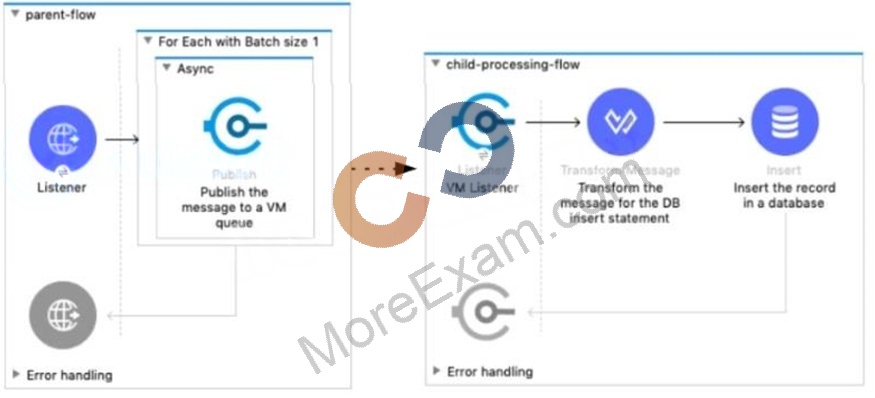
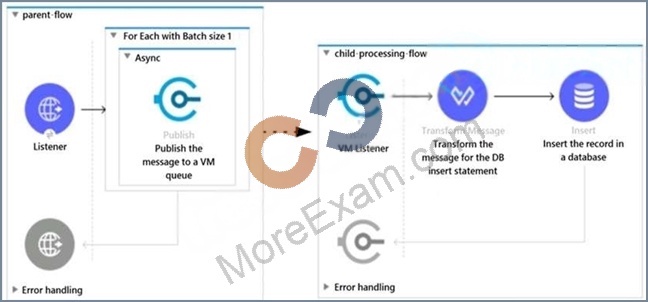
Question79: Refer to the exhibit.A Mule 4 application has a parent flow that breaks up a JSON array payload into 200 separate items, then sends each item one at a time inside an Async scope to a VM queue.A second flow to process orders has a VM Listener on the same VM queue. The rest of this flow processes each received item by writing the item to a database.This Mule application is deployed to four CloudHub workers with persistent queues enabled.What message processing guarantees are provided by the VM queue and the CloudHub workers, and how are VM messages routed among the CloudHub workers for each invocation of the parent flow under normal operating conditions where all the CloudHub workers remain online?
Question80: Refer to the exhibit.An organization deploys multiple Mule applications to the same customer -hosted Mule runtime. Many of these Mule applications must expose anHTTPS endpoint on the same port using a server-side certificate that rotates often.What is the most effective way to package the HTTP Listener and package or store the server-side certificate when deploying these Mule applications, so the disruption caused by certificate rotation is minimized?
Question81: A Mule application is running on a customer-hosted Mule runtime in an organization's network. The Mule application acts as a producer of asynchronous Mule events. Each Mule event must be broadcast to all interested external consumers outside the Mule application. The Mule events should be published in a way that is guaranteed in normal situations and also minimizes duplicate delivery in less frequent failure scenarios.The organizational firewall is configured to only allow outbound traffic on ports 80 and 443. Some external event consumers are within the organizational network, while others are located outside the firewall.What Anypoint Platform service is most idiomatic (used for its intended purpose) for publishing these Mule events to all external consumers while addressing the desired reliability goals?
Question82: An Order microservice and a Fulfillment microservice are being designed to communicate with their clients through message-based integration (and NOT through API invocations).The Order microservice publishes an Order message (a kind of command message) containing the details of an order to be fulfilled. The intention is that Order messages are only consumed by one Mule application, the Fulfillment microservice.The Fulfillment microservice consumes Order messages, fulfills the order described therein, and then publishes an OrderFulfilled message (a kind of event message). Each OrderFulfilled message can be consumed by any interested Mule application, and the Order microservice is one such Mule application.What is the most appropriate choice of message broker(s) and message destination(s) in this scenario?
Question83: An organization is creating a set of new services that are critical for their business. The project team prefers using REST for all services but iswilling to use SOAP with common WS-" standards if a particular service requires it.What requirement would drive the team to use SOAP/WS-* for a particular service?
Question84: An organization is designing a mule application to support an all or nothing transaction between serval database operations and some other connectors so that they all roll back if there is a problem with any of the connectors Besides the database connector , what other connector can be used in the transaction.
Question85: Refer to the exhibit.One of the backend systems invoked by an API implementation enforces rate limits on the number of requests a particular client can make. Both the backend system and the API implementation are deployed to several non-production environments in addition to production.Rate limiting of the backend system applies to all non-production environments. The production environment, however,does NOT have any rate limiting.What is the most effective approach to conduct performance tests of the API implementation in a staging (non-production) environment?
Question86: A Mule application uses the Database connector.What condition can the Mule application automatically adjust to or recover from without needing to restart or redeploy the Mule application?
Question87: An organization needs to enable access to their customer data from both a mobile app and a web application, which each need access to common fields as well as certain unique fields. The data is available partially in a database and partially in a 3rd-party CRM system. What APIs should be created to best fit these design requirements?
Question88: Refer to the exhibit.A business process involves the receipt of a file from an external vendor over SFTP. The file needs to be parsed and its content processed, validated, and ultimately persisted to a database. The delivery mechanism is expected to change in the future as more vendors send similar files using other mechanisms such as file transfer or HTTP POST.What is the most effective way to design for these requirements in order to minimize the impact of future change?
Question89: Refer to the exhibit. A Mule 4 application has a parent flow that breaks up a JSON array payload into 200 separate items, then sends each item one at a time inside an Async scope to a VM queue.A second flow to process orders has a VM Listener on the same VM queue. The rest of this flow processes each received item by writing the item to a database.This Mule application is deployed to four CloudHub workers with persistent queues enabled.What message processing guarantees are provided by the VM queue and the CloudHub workers, and how are VM messages routed among the CloudHub workers for each invocation of the parent flow under normal operating conditions where all the CloudHub workers remain online?
Question90: A Mule application is synchronizing customer data between two different database systems.What is the main benefit of using XA transaction over local transactions to synchronize these two database system?
Question91: Refer to the exhibit.A Mule application is being designed to expose a SOAP web service to its clients.What language is typically used inside the web service's interface definition to define the data structures that the web service Is expected to exchange with its clients?
Question92: A Mule application name Pub uses a persistence object store. The Pub Mule application is deployed to Cloudhub and it configured to use Object Store v2.Another Mule application name sub is being developed to retrieve values from the Pub Mule application persistence object Store and will also be deployed to cloudhub.What is the most direct way for the Sub Mule application to retrieve values from the Pub Mule application persistence object store with the least latency?
Question93: Mule application A receives a request Anypoint MQ message REQU with a payload containing a variable- length list of request objects. Application A uses the For Each scope to split the list into individual objects and sends each object as a message to an Anypoint MQ queue.Service S listens on that queue, processes each message independently of all other messages, and sends a response message to a response queue.Application A listens on that response queue and must in turn create and publish a response Anypoint MQ message RESP with a payload containing the list of responses sent by service S in the same order as the request objects originally sent in REQU.Assume successful response messages are returned by service S for all request messages.What is required so that application A can ensure that the length and order of the list of objects in RESP and REQU match, while at the same time maximizing message throughput?
Question94: A Mule application is built to support a local transaction for a series of operations on a single database. The Mule application has a Scatter-Gather that participates in the local transaction.What is the behavior of the Scatter-Gather when running within this local transaction?
Question95: An organization uses one specific CloudHub (AWS) region for all CloudHub deployments. How are CloudHub workers assigned to availability zones (AZs) when the organization's Mule applications are deployed to CloudHub in that region?
Question96: A retailer is designing a data exchange interface to be used by its suppliers. The interface must support secure communication over the public internet. The interface must also work with a wide variety of programming languages and IT systems used by suppliers.What are suitable interface technologies for this data exchange that are secure, cross-platform, and internet friendly, assuming that Anypoint Connectors exist for these interface technologies?
Question97: A Mule application is deployed to a cluster of two(2) cusomter-hosted Mule runtimes. Currently the node name Alice is the primary node and node named bob is the secondary node. The mule application has a flow that polls a directory on a file system for new files.The primary node Alice fails for an hour and then restarted.After the Alice node completely restarts, from what node are the files polled, and what node is now the primary node for the cluster?
Question98: What aspects of a CI/CD pipeline for Mule applications can be automated using MuleSoft-provided Maven plugins?
Question99: A Mule application is being designed for deployment to a single CloudHub worker. The Mule application will have a flow that connects to a SaaS system to perform some operations each time the flow is invoked.The SaaS system connector has operations that can be configured to request a short-lived token (fifteen minutes) that can be reused for subsequent connections within the fifteen minute time window. After the token expires, a new token must be requested and stored.What is the most performant and idiomatic (used for its intended purpose) Anypoint Platform component or service to use to support persisting and reusing tokens in the Mule application to help speed up reconnecting the Mule application to the SaaS application?
Question100: A Mule application is deployed to a cluster of two(2) cusomter-hosted Mule runtimes. Currently the node name Alice is the primary node and node named bob is the secondary node. The mule application has a flow that polls a directory on a file system for new files.The primary node Alice fails for an hour and then restarted.After the Alice node completely restarts, from what node are the files polled, and what node is now the primary node for the cluster?
Question101: What is true about the network connections when a Mule application uses a JMS connector to interact with a JMS provider (message broker)?
Question102: An integration Mule application consumes and processes a list of rows from a CSV file. Each row must be read from the CSV file, validated, and the row data sent to a JMS queue, in the exact order as in the CSV file.If any processing step for a row fails, then a log entry must be written for that row, but processing of other rows must not be affected.What combination of Mule components is most idiomatic (used according to their intended purpose) when implementing the above requirements?
Question103: Refer to the exhibit.One of the backend systems invoked by an API implementation enforces rate limits on the number of requests a particular client can make. Both the backend system and the API implementation are deployed to several non-production environments in addition to production.Rate limiting of the backend system applies to all non-production environments. The production environment, however, does NOT have any rate limiting.What is the most effective approach to conduct performance tests of the API implementation in astaging (non-production) environment?
Question104: An external REST client periodically sends an array of records in a single POST request to a Mule application API endpoint.The Mule application must validate each record of the request against a JSON schema before sending it to a downstream system in the same order that it was received in the array Record processing will take place inside a router or scope that calls a child flow. The child flow has its own error handling defined. Any validation or communication failures should not prevent further processing of the remaining records.To best address these requirements what is the most idiomatic(used for it intended purpose) router or scope to used in the parent flow, and what type of error handler should be used in the child flow?
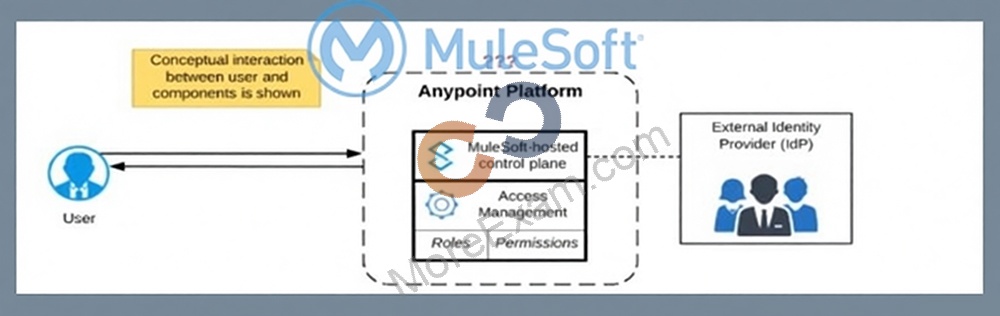
Question105: Refer to the exhibit.Anypoint Platform supports role-based access control (RBAC) to features of the platform. An organization has configured an external Identity Provider for identity management with Anypoint Platform.What aspects of RBAC must ALWAYS be controlled from the Anypoint Platform control plane and CANNOT be controlled via the external Identity Provider?
Question106: Refer to the exhibit.This Mule application is deployed to multiple Cloudhub workers with persistent queue enabled. The retrievefile flow event source reads a CSV file from a remote SFTP server and then publishes each record in the CSV file to a VM queue. The processCustomerRecords flow's VM Listner receives messages from the same VM queue and then processes each message separately.How are messages routed to the cloudhub workers as messages are received by the VM Listener?
Question107: Refer to the exhibit.A Mule application is being designed to be deployed to several CIoudHub workers. The Mule application's integration logic is to replicate changed Accounts from Satesforce to a backend system every 5 minutes.A watermark will be used to only retrieve those Satesforce Accounts that have been modified since the last time the integration logic ran.What is the most appropriate way to implement persistence for the watermark in order to support the required data replication integration logic?
Question108: An XA transaction Is being configured that involves a JMS connector listening for Incoming JMS messages.What is the meaning of the timeout attribute of the XA transaction, and what happens after the timeout expires?
Question109: Additional nodes are being added to an existing customer-hosted Mule runtime cluster to improve performance. Mule applications deployed to this cluster are invoked by API clients through a load balancer.What is also required to carry out this change?
Question110: Refer to the exhibit.A Mule application is being designed to expose a SOAP web service to its clients.What language is typically used inside the web service's interface definition to define the data structures that the web service Is expected to exchange with its clients?
Question111: An organization's security requirements mandate centralized control at all times over authentication and authorization of external applications when invoking web APIs managed on Anypoint Platform.What Anypoint Platform feature is most idiomatic (used for its intended purpose), straightforward, and maintainable to use to meet this requirement?